


Convention Used of Music Video
Video
Within our music video we have used many conventions that allow our video to actually look like a music video.Our fist, and most obvious convention is the layout of the video so that there is a recognisable music video style and it does look like a short film, this was achieved by having a performance and a narrative that were spread throughout the video. This is a convention used my most artists and is possibly the simplest way to show it is a music video. A second convention we used was our actors. They were selected as they met the genre exactly something done by hundreds of artists world wide. Because of this we were able to film shots in locations that were not complete representations of indy rock such as the road. Following on from this the next convection we used was fashion. When selecting the outfits for our actors we first looked at what other artists tended to wear in their videos. From this we found that the clothes are both fashionable but also tend to stand out.
Narrative Performance One of the outfit choices
Software
Within the software side of the music video we also used many different conventions to keep to some of the many stereotypes of what makes a music video a music video. Camera movement was the first, we considered this both in planning and while we were actually filming. From our research we knew that shots such as close up, extreme closeups, mid shots, track shots and even still shots are very popular and definite convections in music videos. As a result of this we made a list of all the shots we wanted and matched them to the shots we thought would work well in. Using the plan we filmed all the shots we needed which and because they were already planned they automatically linked with music. When filming we ensured that we filmed each shot more than three times so when it came to editing we knew we would have the shot we needed. This is something done by most directors in the music industry. After every shoot we watched the footage so that there was no chance that we had missed a shot. The shots we chose to use such as slow zooms and close ups were all there to create more emphasis on the artists, location and props. predominantly however like many other music videos we not only used the close ups to show emotions but to also capture and show the meaning of the words in the song. The next convention we used what the editing software itself, we decided to use final cut pro for this as it is the best editing software we were able to use. The program itself is a very well used product throughout the industry and used my many editors all over the world for music videos.
Close up shot Example of slow zoom Showing the props (cross)
Hardware
There is not a huge amount of conventions in the hardware department however, there are certainly a few worth mentioning. The two that we have used in our music video is the cannon camera SLR which was used to film a small amount along side the 2016 apple MacBook Pro. These (leaning more towards the macbook) are used by directors, editors and camera men/women throughout the industry. The macbook especially is an essential peace of hardware that is most defiantly the computer of choice for meany if not all big music labels to use in the production of their music videos.
f
Cannon SLR Mac Book Pro
Editing
Within the sub-heading of editing there are may convections, jump-cuts are the most predominate transition between shots as they allow for the sudden change in location or angle which keeps the audience interested. We have have used this convection all the way through our video with the exception of one shot. There an endless amount of examples in our video one of which is where we jump-cut to show the drums getting further and further away from the camera also representing the lyrics. Just as jump-cuts are used fade to blacks are and depending on the genre of the music video they are the second most popular transition that is used. The only example we have in our video is at the very end where our actor walks off but this is one more example of convention we have used.
Example of the jump cuts
Mise-en-scene
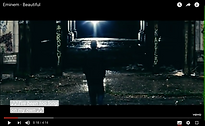
There are many Mise-en-scene conventions that music videos use. This is no different from our own. Just as in nearly every other music video that has made mise-en-scene has had a huge part to play in them all. First of all the the positing of actors. The places in which our actors stand is no coincidence, each one was planned so that we could keep the audiences attention on the exactly what we wanted them to. This however was mostly for the actors as we wanted to keep them in the centre of shot for all the rural locations in music videos. The reason for this is because there is usually so much more to look at in a location such as this that audience need to be focused on the artists themselves to ensure they have a more immersive experience of the overall music video. In a shot where we involve smoke we wanted the audience to focus their attention on to the speed of the smoke itself and not as much on the actors and so we positioned them either behind the smoke or completely out of shot for some time. This allowed us to slow the overall speed of the video up or down. This is just two examples where positioning of actors made the audience focus on the specific things we needed them to. This is a technique used by many if not all editors and directors when they are creating music videos. Clothing was the next peace of mise-en-scene which we followed many conventions of. Although it is hard to truly pinpoint our song as a specific genre the age of the actors and the style of the song for us determined the clothing that was going to be worn. What we ensured was that each outfit had one standout feature to give each artist a sort of trade mark. This consisted of sunglasses, necklaces, a bandanna, fear coat and yezzez. (This was more of a subtle convention that is not straight away noticed but makes a huge impact when the music video is viewed as a whole). With each location change we also changed the outfit of both actors along with the stand out peace they were wearing. Again this is a very normal convention of music videos of our style one example of this is Lil Wayne in Sucker for pain where he has a very typical rapper outfit but a bright red bandanna. A standard convention Mise-en-scene is to use it for representation one example of this is Eminem in Beautiful where he walks around an abandoned vandalised church and talk to God about his depression. The church shows how he is feeling in himself. Similarly the light is kept very low key and dark along with the clothes very plane with the props kept to a minim. Things like this are common conventions in music videos. Within our video we also used representation through Mies-en-scene to show how things in the old days thins were better. In one shot we show our actors sitting on a half-pipe ramp with an idyllic sun in the sky at the same point one character puts his arm around the other in an achieving happy way. This mixed in with the slow pan and the bright lighting and the lens flare show that they are thinking about when they were happy with no worries in the world.
Positioning of actors (out of shot) Five examples of props
Stand out peace example Example of Representation


When creating my digipak i first used a template to understand and design the images which would be included on the digipak. It also helped me to visualise the digipak and see how it would look to the audience who bought it Adding to the fact that the correct sizes were already included on the template it meant i would save time positioning the images. I used the sizes of the template to obey the convention of size in digipaks, if ever i wanted to print the digipak and make it this would all be possible and would ensure that text and images would not be out of place. This was all done to make the digipak as professional as possible. I could see from the templates that i needed binders which needed to include numbers and specific typography that matched the rest of the digipak. On there actual digipak there were many conventions which needed to be included to make it an actual digipak. things such as; Name of the album, name of the band, a price tag, a tracklist, the record label logo on the back cover and a photo of the artist/band. All these obvious things are what allowed me to create a digipack which was instantly recognisable to the general public. one convention of music videos which we used was matching it to the genre of the music indy rap is a very complex gene but it can be narrowed down to utopia and dystopia because of this i decided to incorporate this heavily into the front of my digipak i made the image very dark with the words of the lyrics printed in black and white across an image of our actor, on some of the image or actor was wearing a denim jacket and this i kept this in full colour. the dark side of the image was for the dystopia and the bright jacket was for the utopia side of the genre.
Just as i did with my digipak i included many of the conventions of digpak poster. Some things i included on the digipak was the name of the band/artist, name of the album/product being advertised, a relevant photo, artist/band website and vital information again thesis simple things are all the elements which allow me to produce a document which very much resembles a professional digipak poster. The typography which i opted to use was very specific this was to grab the attention of passers by on the street. the combination of the colours along with the interesting picture allows for a very attention grabbing digipak poster as well as telling the story of the music video stressed out.